

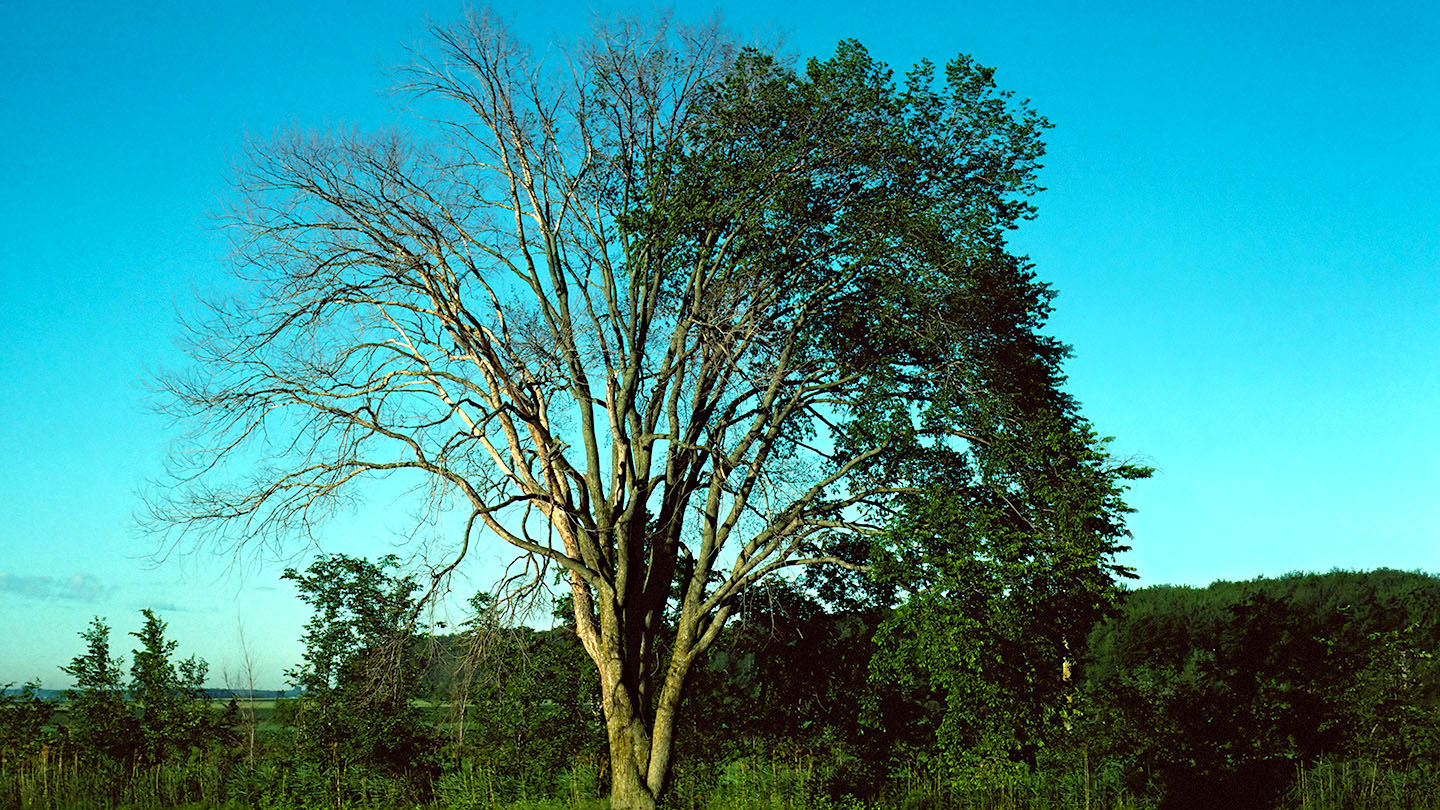
Dutch elm disease (DED) was first brought to North America during the Second World War when infected elm lumber was imported from Europe and has been slowly making its way towards Alberta ever since. Fortunately, there have been only a few isolated cases in the province, with one being in Wainwright in 1998 and, more recently, in Lethbridge in 2020. Aside from these cases, Dutch elm disease is not common in Alberta, despite there being carriers in the province since the 1990’s.
Dutch elm disease kills American and Siberian elm trees within months of infection and spreads rapidly. Arborists and government officials in Alberta are aware of the impact this disease could have on the province, and it is because of this diligence that Alberta has one of the last healthy elm populations in the world. This article will discuss the ways in which we can continue to protect our elm trees by helping you understand the issue and the steps we take to prevent DED in Alberta.
The Problem
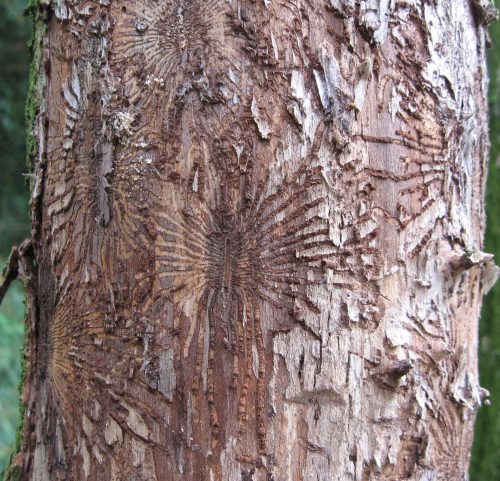
Dutch elm disease is a lethal attack on elm trees perpetrated by two nasty villains: Elm Bark Beetles and fungus. There are three varieties of the Elm Bark Beetle: Native Bark Beetle, Smaller European Elm Bark Beetle, and the Banded Elm Bark Beetle. All three can carry DED and attack elm trees in similar ways. In the spring they search for dying elm trees or elm deadwood to bore into. These trees become brood trees where the beetles will build galleys and lay their eggs. After the eggs hatch, the larvae will feed on the inner bark layers of the tree until emerging as adults. This process will be repeated two to three times a season, depending on the weather conditions. The adults will briefly feed on healthy elm wood before searching for a new host, which is how the disease can spread so quickly.
While the bark beetles carry the disease and help accelerate its spread, the actual damage is caused by the funguses Ophiosoma Ulmi and O.Novo-Ulmi. These fungi are extremely aggressive and reproduce both asexually and sexually. They will use the beetles, the beetle’s galleys, and the trees’ natural distribution system to spread through the tree, killing it systematically. This process can take only a few months with aggressive infections or longer when conditions are not favorable for the beetle and fungus.
Once a tree is infected with Dutch elm it attracts even more bark beetles causing the disease to spread more rapidly, making it more difficult to be dealt with. Therefore, immediate removal of infected trees is a priority.
The Victims
Elm trees are the only victims of Dutch elm disease (DED). They can be identified by their classic vase-shaped form, with a strong central trunk and a wide, upward-spreading canopy. Their leaves are oblong with uneven serrated edges and distinct veins, dark green on top and lighter underneath. Mature bark is rough and ranges from grey to brown, sometimes appearing black due to sooty mold caused by elm scale.
Bark beetles typically target mature elms—especially larger, multi-stemmed trees that can support long-term infestation.
American elms are large, fast-growing trees with a tidy, upright shape, often reaching up to 100 feet tall. Siberian elms are smaller, with a more irregular form and shorter lifespan, though they are somewhat more resistant to DED.
Other varieties, such as Chinese, Brandon, and Little Leaf elms, as well as hybrid cultivars, may offer some resistance—but no elm is completely immune to DED.
The Symptoms
The symptoms of Dutch elm disease (DED) are relatively easy to recognize, while signs of bark beetle infestation can be much harder to detect—especially in the early stages.
Bark beetle infestations are often overlooked at first because the insects are extremely small. Their entry holes are about the size of a ballpoint pen tip, but with careful inspection, they can be identified. Look closely for frass (fine sawdust) around these holes and on the ground near the base of the tree. As an infestation grows, the amount of frass at the base will typically increase.
It is also common to see rows of holes in elm bark caused by sapsucker birds. These holes are larger than bark beetle entry points and are usually arranged in neat, horizontal or vertical lines. Unlike bark beetles, sapsuckers generally do not kill healthy trees unless the tree is already stressed or declining.
If an elm tree is damaged or being removed, you may find clearer evidence of bark beetles beneath the bark. Distinct galleries—tunnel-like patterns where beetles have burrowed and laid eggs—are often visible and confirm infestation.
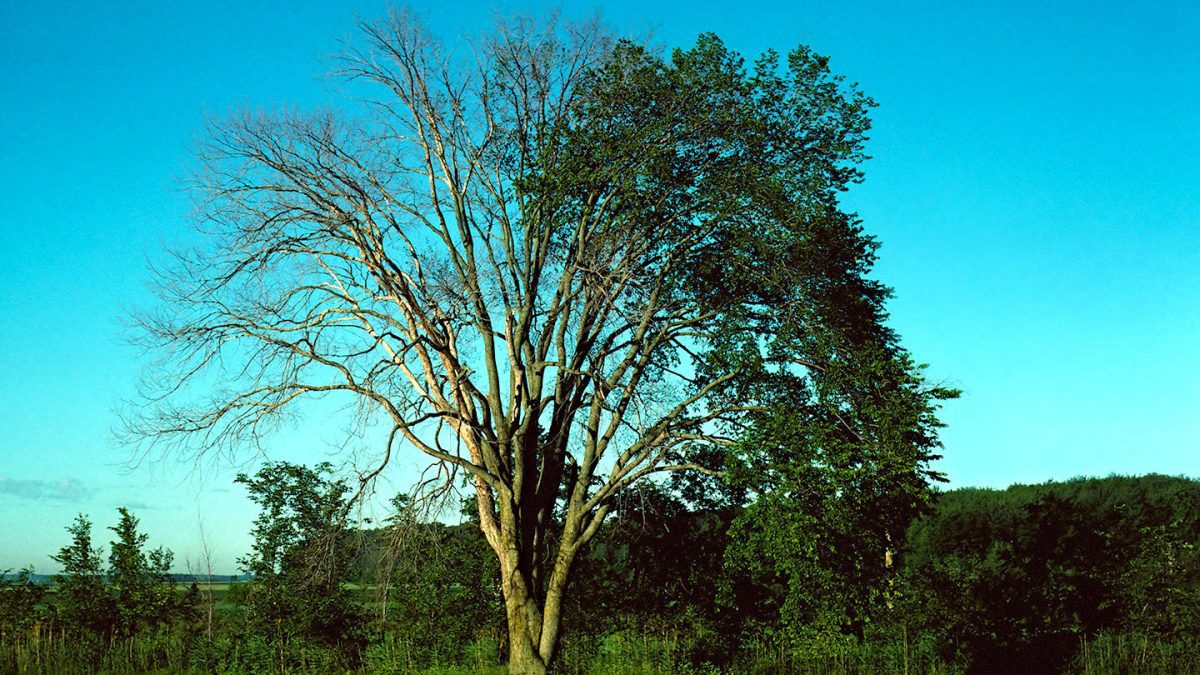
In contrast, DED symptoms are much more noticeable. The first sign is typically the sudden wilting and yellowing of leaves on one or more branches, often appearing in late June through July. As the disease progresses, the leaves turn brown and may remain attached for a time before falling. By early fall, the tree’s canopy may thin significantly or drop its leaves earlier than expected.
It is important to note that DED symptoms often appear alongside evidence of bark beetle activity, as the beetles are a primary vector for spreading the disease.
What can be done
Preventing Dutch elm disease (DED) is the most effective way to protect elm trees in Alberta. This starts with following local bylaws and keeping trees healthy, as bark beetles are attracted to stressed or dying elms.
- Monitor your trees regularly. If you notice symptoms of DED, report it by calling 311. For city-owned trees, email citytrees@edmonton.ca; for private trees, contact treebugs@edmonton.ca. A certified arborist can also help with identification and treatment.
- Only prune elm trees between October 1 and March 31, when bark beetles are inactive. Avoid storing or transporting elm firewood—dispose of it through approved city programs or arborists.
- Maintain tree health by removing deadwood during pruning season, watering during drought and in the fall, and fertilizing appropriately. Be sure to water around the drip line, not the trunk, and avoid overwatering. Check newly planted trees to ensure stakes and wires aren’t causing damage.
- Keep an eye out for pests like aphids, thrips, and leaf rollers, and address infestations early. Also be aware of Dothiorella, a disease that can resemble DED but typically lacks significant bark beetle activity.
What Kentucky Blue Grass Can Do for You
Our certified arborists can accurately diagnose issues, prune problem areas, and support long-term tree health through deep root fertilization and proper watering. We also treat common elm pests such as elm scale, aphids, leaf rollers, and thrips.
If an elm tree is damaged, declining, or poses a risk, our team can safely and efficiently handle its removal.